NotesNovember 2026Planning explained
Building work finished before 25 April 2024 keeps the four-year limit.
Since 25 April 2024 a council in England has ten years to take enforcement action against building work carried out without planning permission. Work substantially completed before that day keeps the old limit of four years.

Take an extension built without planning permission and finished in November 2021. The council had four years from then to take enforcement action, so unless an exception applies, its time ran out in November 2025. Had the same extension been finished in May 2024, the council would have until May 2034. One date separates the two cases. On 25 April 2024 the time limit for building work in England rose from four years to ten.
The limit for building work is now ten years.
The time limits for enforcement are in section 171B of the Town and Country Planning Act 1990. Section 115 of the Levelling-up and Regeneration Act 2023 changed them for England, and the change came into force on 25 April 2024.
For building, engineering, mining or other operations carried out without planning permission, no enforcement action may now be taken after the end of ten years beginning with the date on which the operations were substantially completed. A change of use of a building to a single dwellinghouse moved from four years to ten at the same time. Every other breach of planning control already had ten years, apart from relevant demolition, which has no limit at all. In Wales the four-year limits still apply.
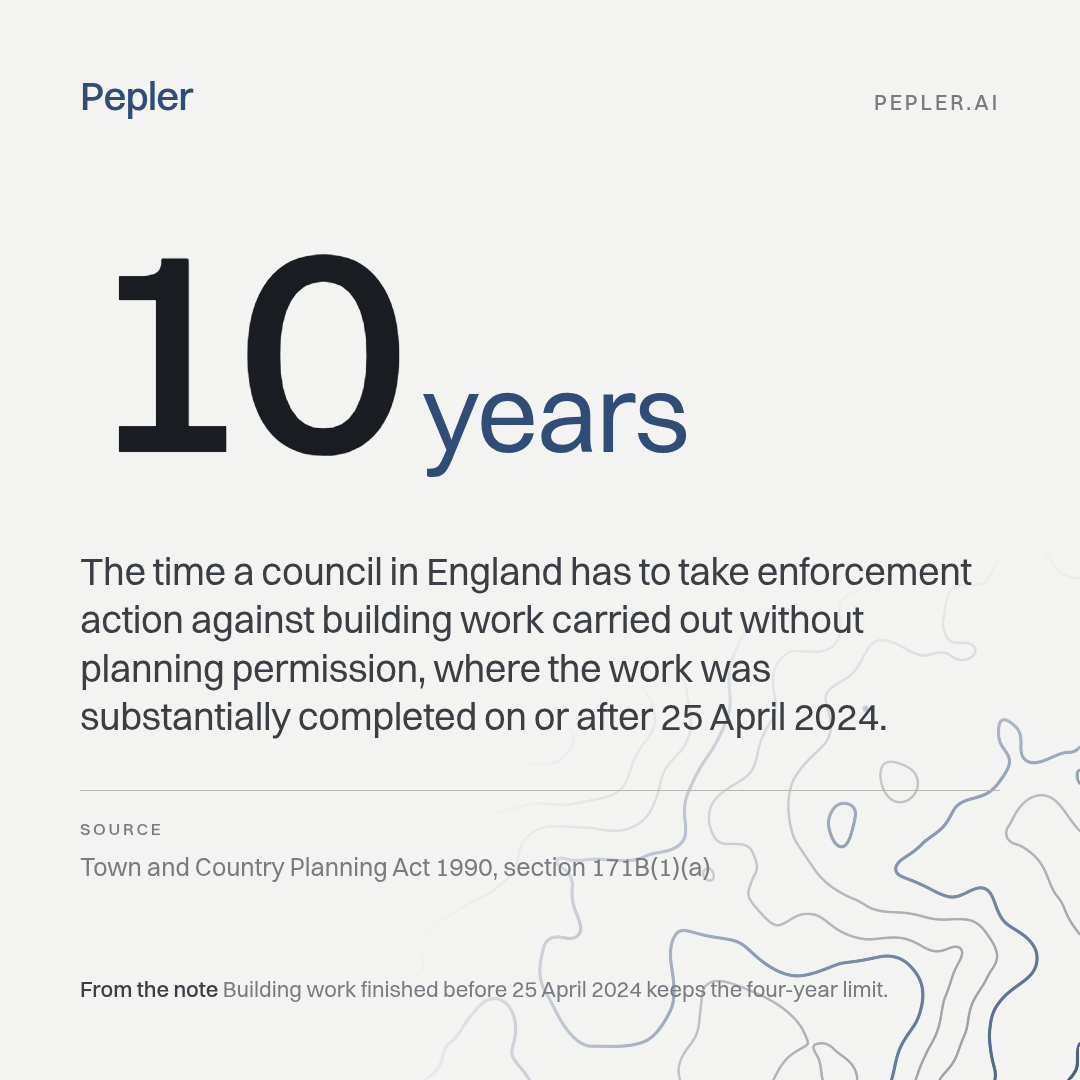
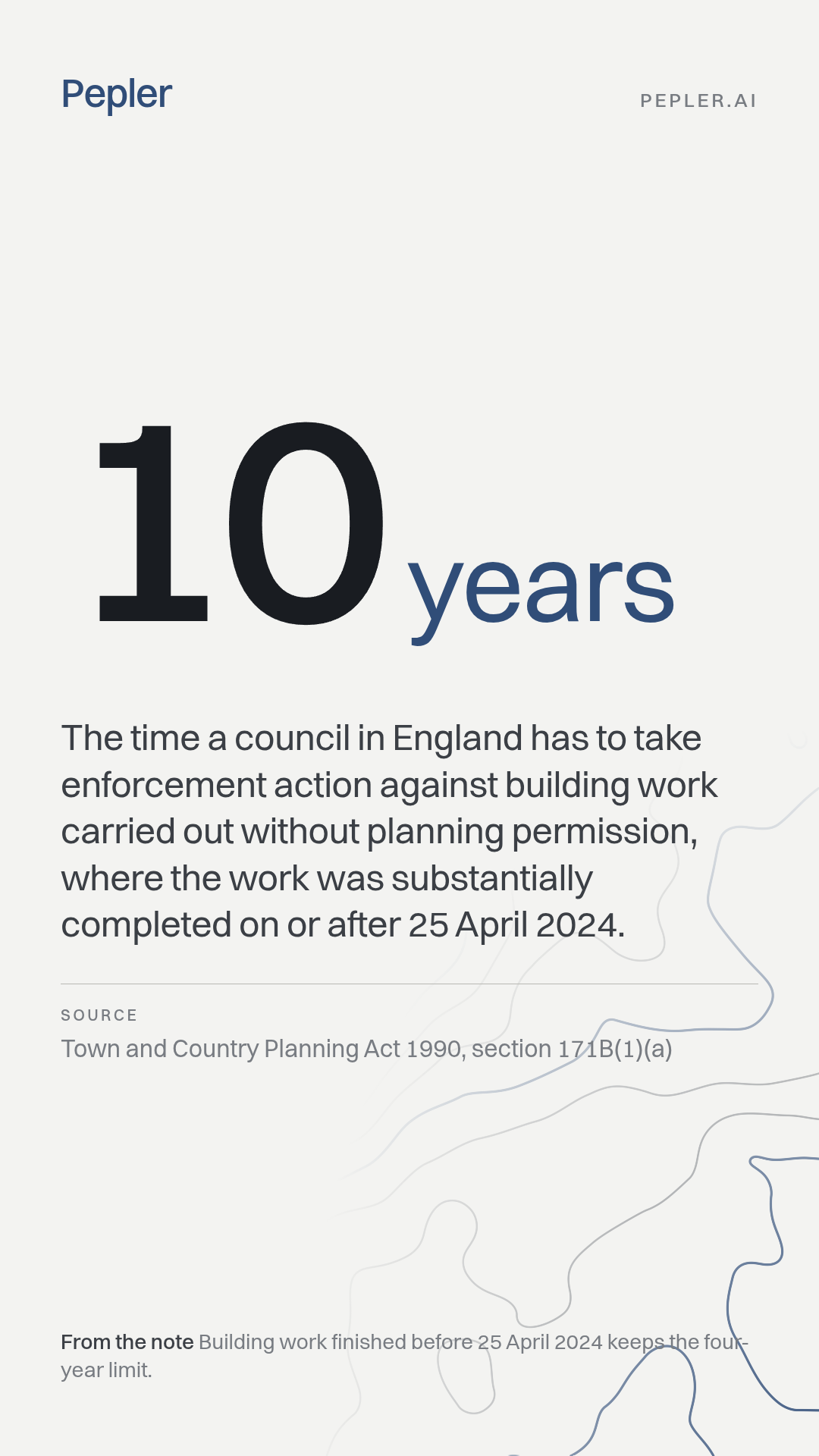
The time a council in England has to take enforcement action against building work carried out without planning permission, where the work was substantially completed on or after 25 April 2024.
Source Town and Country Planning Act 1990, section 171B(1)(a)
Work finished before that day keeps four years.
The change does not reach back to work that was already finished. The regulations that brought section 115 into force say so in terms.
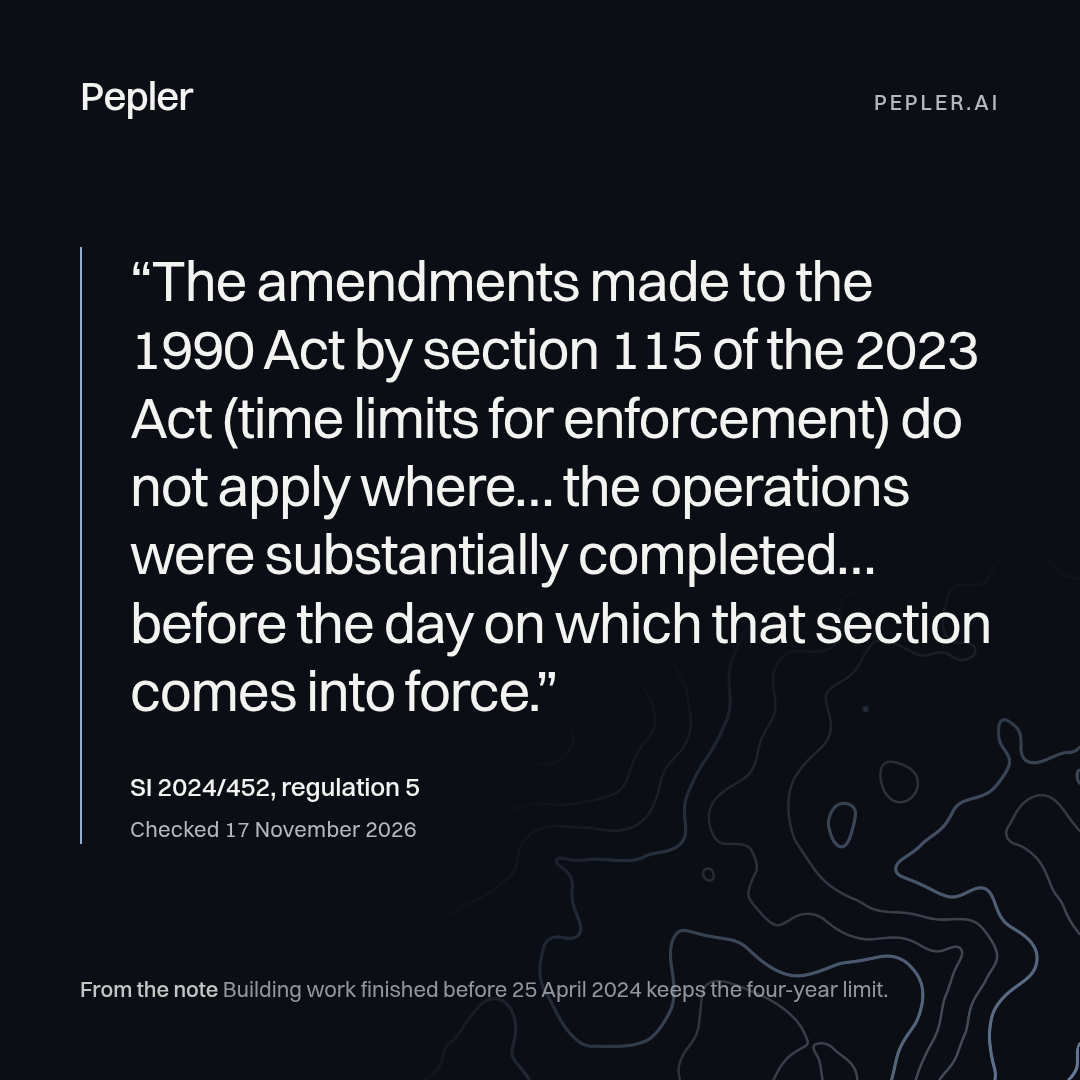
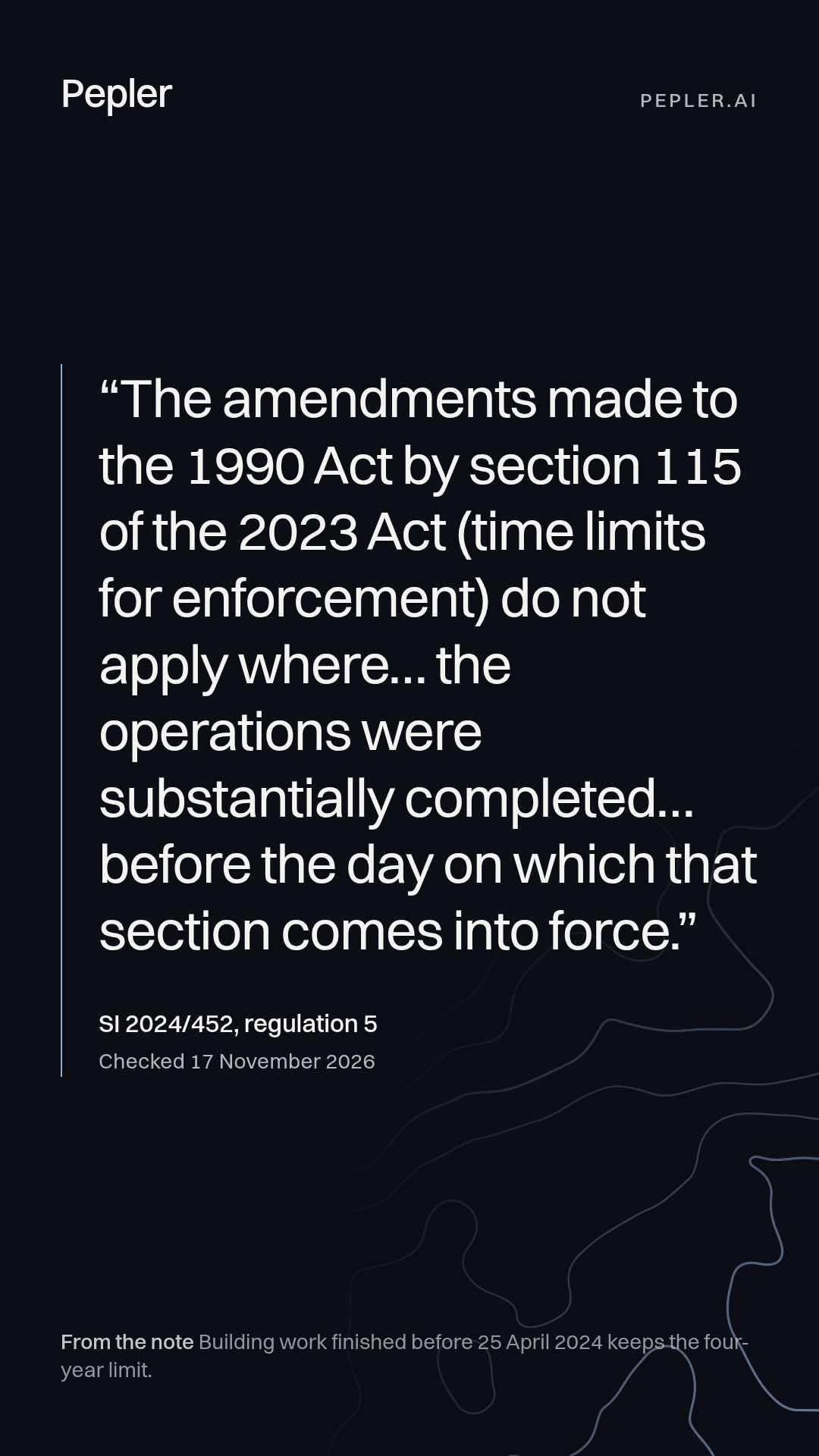
The amendments made to the 1990 Act by section 115 of the 2023 Act (time limits for enforcement) do not apply where… the operations were substantially completed… before the day on which that section comes into force.
For that work, section 171B(1) applies as it stood before the change. No enforcement action may be taken after the end of four years beginning with the date on which the operations were substantially completed. A change of use to a single dwellinghouse that took place before 25 April 2024 also keeps its four years.
The clock starts when the work was substantially completed. The day it began does not count, and neither does the day anyone noticed it.
The owner has to prove the date.
The usual way to settle the position is a certificate of lawfulness of existing use or development under section 191 of the 1990 Act. Uses and operations are lawful for the purposes of the Act if no enforcement action may then be taken against them and they do not breach an enforcement notice in force. Once a certificate is in force, that lawfulness is conclusively presumed.
The evidence is the applicant's to provide. Planning practice guidance says the applicant is responsible for providing sufficient information to support an application. Where the council has no evidence of its own, or from others, that makes the applicant's version of events less than probable, the guidance says there is no good reason to refuse. The condition is that the applicant's evidence is precise and unambiguous enough to justify a certificate on the balance of probability.
Concealment can keep the time open.
Two rules let a council act after the limit where a breach was hidden. The first came from the courts.
Mr Beesley had planning permission for a hay barn in the Green Belt near Potters Bar. The building he put up looked like a barn from outside. Inside it was a house with three bedrooms, and on 9 August 2002 he and his wife moved in. The council did not know. On 15 August 2006, four years later, he applied for a certificate that the use was lawful. On 6 April 2011 the Supreme Court held that he could not rely on the time limit, and set the certificate aside.
The second is in the Act. Since 6 April 2012 a council in England can apply to a magistrates' court for a planning enforcement order under section 171BA. The court can make one only if it is satisfied, on the balance of probabilities, that the apparent breach has to any extent been deliberately concealed, and it considers the order just in all the circumstances. The council must apply within 6 months of the date on which it had evidence it judged sufficient to justify the application. An order gives the council an enforcement year in which it can act, whether or not the limits in section 171B have expired.
The extension finished in November 2021.
If that extension was substantially completed in November 2021, the four-year limit applies to it, and it ran out in November 2025. The council could still act if the breach was deliberately concealed, through a planning enforcement order or on the principle the Supreme Court applied in 2011. It could also act if it had taken enforcement action against the same breach in the four years before acting again. Otherwise no enforcement action may be taken, and the owner can apply for a certificate under section 191 to record that the extension is lawful.
Sources: the Town and Country Planning Act 1990, sections 171B, 171BA, 171BB, 171BC and 191 as in force on 3 November 2026, and section 171B as it stood on 24 April 2024; the Levelling-up and Regeneration Act 2023, section 115; SI 2024/452, regulations 3 and 5; Planning Practice Guidance on lawful development certificates, paragraph 006; and Secretary of State for Communities and Local Government v Welwyn Hatfield Borough Council [2011] UKSC 15, the judgment. All were checked at source on 3 November 2026.